Somebody told you long hair “makes your face look longer”, somebody else said short hair does, and the salon gives you the same layers every time regardless. Searching oblong face shape hairstyles mostly returns Hollywood photo lists that say nothing about thick South Asian hair, hijab styling, or what survives a Karachi summer. This guide fixes that: how to confirm your face is actually oblong, the one rule every flattering style follows, the cuts that work, the ones to skip, and how it all applies to desi hair, hijab and shaadi season.
First, is your face actually oblong?
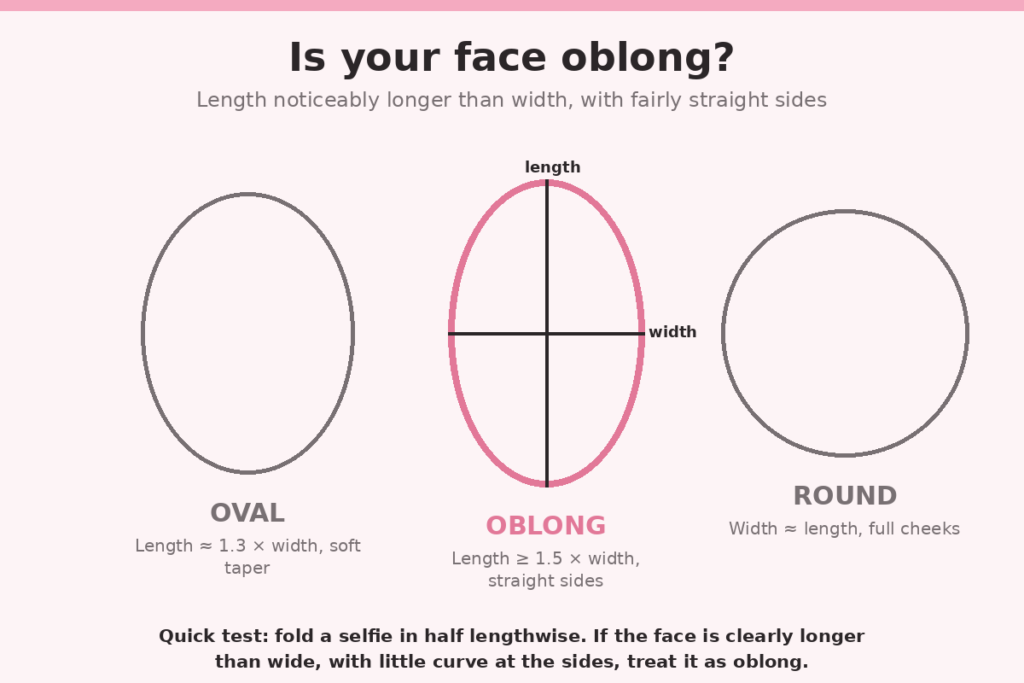
An oblong face is noticeably longer than it is wide, with fairly straight sides and often a longer lower half. It is sometimes called a long or rectangular face; the rectangle version simply adds a squarer jaw. The confusion is almost always with oval: oval is also longer than wide, but gently tapered and balanced, which is why most styles suit it.
Two quick checks. One: pull all your hair back in a selfie and look at the outline, not the features. If the sides run almost straight down and the face reads clearly longer than wide, you are in oblong territory. Two: the three-section check. Forehead hairline to eyebrows, eyebrows to nose tip, nose tip to chin. On oblong faces these sections are long and fairly equal, where round and heart faces have one clearly shorter section.
If you sit between shapes, do not stress the label. Borderline oval-oblong faces can take almost anything; the rules below just become gentle suggestions instead of rules.
The one rule for oblong faces
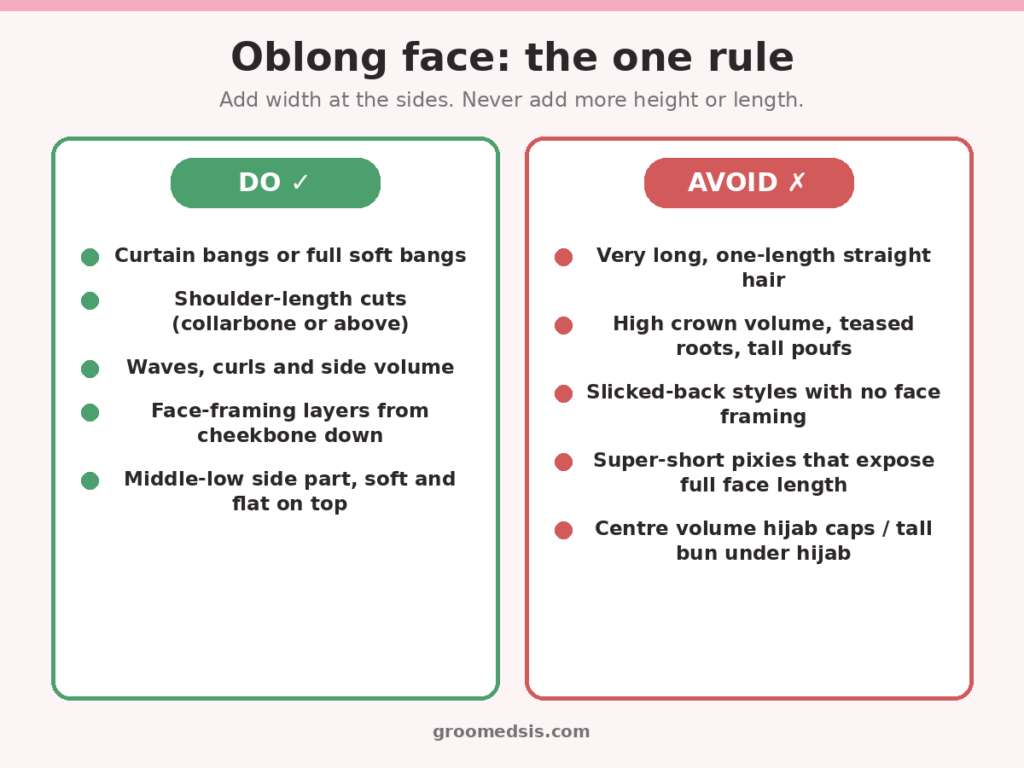
Every flattering oblong style does the same two things: it adds width at the sides of the face, and it avoids adding height on top or empty length below. That is the entire science. Width comes from waves, curls, layers that kick out at cheek or jaw level, and fuller sides. Visual shortening comes from bangs that lower the hairline, and from cuts that end where you want the eye to stop, usually between the chin and the collarbone.
Keep that rule in mind and you can judge any style yourself, including ones no list mentions. Tall crown volume, slicked flat sides, one-length rope-straight lengths to the waist: all of them stretch the face. Soft width at the cheeks: shortens it.
The 8 most flattering hairstyles for oblong faces
1. Curtain bangs
The single best starting point. Curtain bangs lower the visible hairline, split to frame both cheeks, and add width exactly where an oblong face needs it, without the commitment of full bangs. They suit straight and wavy desi hair, grow out gracefully, and survive being tucked behind the ears on hot days.
2. Full, soft bangs
A straight-across but wispy fringe can visually take two inches off face length. The key word is soft: heavy, blunt, helmet-straight bangs on very thick hair can look severe, so ask for them point-cut and slightly thinned, with the bang section kept narrow so it does not become a thick curtain pulling forward.
3. The collarbone cut (lob) with face-framing layers
Shoulder or collarbone length is the sweet spot for oblong faces: long enough to feel long, short enough that the style ends before it drags the face down. Add layers starting at cheekbone or jaw level so the sides carry movement. For thick subcontinental hair this is also the most practical everyday cut, because the layers remove weight.
4. The chin-to-jaw bob
A bob ending between chin and jaw puts a horizontal line exactly where an oblong face wants one. Slightly A-line, or with soft internal layers, works better on thick hair than one blunt line, which can balloon into a triangle as the hair dries. If you have been waiting for an excuse for a dramatic chop, your face shape just handed you one.
5. Waves and curls, worn with side volume
Texture is width. Loose waves at the cheeks and jaw do more for an oblong face than any cut alteration. If your hair has natural wave or curl, stop ironing it flat; if it is poker straight, braid-set waves or heatless curlers do the job overnight, and our guide to heat-free styling shows the gentle ways to get there.
6. Layered long hair, if you keep your length
You do not have to cut your hair short. Long hair works on oblong faces on one condition: it cannot hang in one flat length. Face-framing layers from the cheekbones down, plus long internal layers for movement, break the vertical line. Pair long hair with curtain bangs and you keep the length while following the rule completely.
7. The right part, kept low and soft
Parts matter more than most lists admit. A soft middle part works when paired with curtain bangs or waves, and a side part adds a diagonal that cuts the vertical line. What matters more than the side-versus-middle debate is what happens above it: keep the roots relatively flat on top and push the fullness to the sides, whichever part you choose.
8. Side-swept and low updos
When hair must go up (heat, work, events), avoid the tall topknot. A low bun or chignon at the nape, a braid swept over one shoulder, or a low ponytail with face-framing pieces pulled out all keep the eye low and wide rather than high and narrow.
What to avoid (and the fixes)
- Waist-length, one-length, dead-straight hair. The classic desi look is also the single most lengthening style possible. Fix: keep the length, add layers and waves.
- Height at the crown. Teased roots, tall poufs and high buns add centimetres to an already long face. Fix: move the volume to the sides or the nape.
- Fully slicked-back styles. The snatched bun exposes the full length of the face with no interruption. Fix: pull out soft face-framing strands, or keep a curtain bang out.
- Ultra-short pixies. With nothing framing the face, length dominates. If you want short, the chin bob is the safer bold move.
- A flat centre part with no bangs. A flat middle part plus two straight falls of hair creates three vertical lines. Fix: curtain bangs, or at minimum waves.
For thick, wavy South Asian hair specifically
Most oblong-face advice assumes fine, straight Western hair. Thick desi hair changes the playbook in three ways.
First, weight removal is not optional. Heavy hair pulls every layer straight down, which quietly re-creates the vertical line you are trying to break. Ask for internal layers or careful weight removal so the layers actually bend and kick out at the cheeks instead of collapsing.
Second, your texture is an asset. The natural wave most subcontinental hair carries is exactly the width an oblong face needs. Enhance it with a diffuser or overnight braids instead of flat-ironing it away. If your waves frizz rather than form, a weekly hair mask for coarse, frizzy hair and avoiding the common curly hair mistakes will do more than any cut.
Third, protect what frames your face. Bangs and face-framing layers mean regular styling, which usually means regular heat on the exact pieces everyone sees. Learn the signs of heat damage early, because fried face-framing wisps defeat the whole plan. And if you are shedding heavily, fix the foundation first with a proper hair fall routine; the best-shaped cut cannot hide thinning front sections.
Hijab styling for oblong faces
Hijab framing follows the same geometry as hair. What lengthens the face: tall volumising caps or a high bun underneath, tight wraps pulled straight down past the cheeks, and styles that bare the full forehead while hugging the sides. What balances it: a little looseness and width beside the cheeks, the undercap worn slightly forward to lower the visible hairline, folds and draping that create horizontal lines, and volume kept low at the nape rather than on top. Side-draped styles that cross the forehead diagonally are especially flattering, because they break the vertical line exactly the way bangs would.
Bridal and shaadi-season looks
Desi bridal styling loves height: tall jooras, poufs, dupattas pinned at the crown. On an oblong face every one of those stretches the face further, and wedding photography (straight-on, flash, full-face) exaggerates it. Ask your stylist for a low, wide joora at the nape instead of a tall one, soft curled pieces framing both cheeks, and a dupatta pinned wider rather than higher. Jewellery helps too: a maang teeka or matha patti adds a visual break across the forehead, which shortens it, especially worn with soft framing pieces rather than a fully bared hairline.
FAQ
Is long or short hair better for an oblong face?
Neither wins automatically; the finish matters more than the length. Short works when it ends between chin and collarbone with side movement. Long works when it carries layers, waves or bangs that add width. The only real loser is one-length, flat-straight hair at any length, because it adds vertical line with no interruption.
Do bangs suit oblong faces?
Yes; bangs are the signature oblong-face move. They lower the visible hairline and shorten the face more than any cut can. Curtain bangs are the safest entry point, full soft bangs the strongest effect. On thick hair, keep them wispy and point-cut so they stay soft instead of heavy.
Middle part or side part for an oblong face?
Both can work, which surprises people. A side part adds a flattering diagonal, while a middle part is fine when paired with curtain bangs or waves. The real rule sits above the part: keep crown volume low and push fullness to the sides, whichever parting you choose.
What is the difference between oblong and oval?
Both are longer than wide, but oval is shorter, softer and tapers gently to the chin, while oblong is clearly longer with straighter sides and often a longer lower face. If your face reads balanced from hairline to chin, treat it as oval. If the mirror says “long” before anything else, use the oblong rules.
My face is oblong and my forehead is big. What helps most?
Bangs, without question. A curtain or full soft fringe lowers the visible hairline, which shortens the forehead and the whole face in one move. Avoid slicked-back styles and tall crown volume, and when you wear your hair up, keep side-swept pieces crossing the forehead diagonally.
The bottom line
An oblong face does not need fixing; it needs width, not more length. Confirm the shape with the selfie test, then pick any style that adds softness at the sides: curtain bangs, a collarbone cut with layers, waves, or a low wide joora on the big day. Save the do-and-avoid chart for your next salon visit and judge every suggestion against the one rule. Your face shape just stopped being a mystery and became a filter.