The growing debate around natural camphor vs synthetic camphor has captured the attention of health-conscious consumers, aromatherapy enthusiasts, and Ayurvedic practitioners worldwide. Camphor has served humanity for thousands of years across Asian and Mediterranean cultures for its remarkable therapeutic, spiritual, and insect-repellent properties.
However, with the rapid rise of industrial manufacturing, synthetic camphor flooded the global market as a significantly cheaper alternative. Most consumers cannot tell the difference just by looking at it, which raises one critical question: does the source actually matter?
In this comprehensive guide, we break down the key differences between plant-based camphor and chemically derived camphor, examining everything from chemical composition and proven health benefits to safety concerns and practical everyday applications. Whether you are shopping for Ayurvedic camphor tablets, seeking a natural mosquito repellent, or simply making a safer household purchase decision, this article has you covered.
According to the National Center for Biotechnology Information (NCBI), camphor compounds vary significantly in purity and biological activity depending on their origin, a fact that directly impacts both safety and effectiveness. ¹
By the end of this guide, you will have a clear, science-backed understanding of camphor types and uses, empowering you to confidently choose the right product for your health, home, and spiritual rituals.
Table of Contents
What is Camphor? A Brief Overview
Camphor is a waxy, white crystalline substance with a strong, highly distinctive aroma. It belongs to the terpenoid class of organic compounds and carries the chemical formula C₁₀H₁₆O. Historically, camphor has been deeply embedded in traditional medicine systems including Ayurveda, Traditional Chinese Medicine (TCM), and ancient Greek healing practices.
For centuries, it has been used to treat respiratory conditions, relieve muscle pain, repel insects, and serve important ceremonial and spiritual purposes across South Asia and East Asia. Today, camphor is commercially available in two distinct primary forms, and understanding the difference between natural camphor vs synthetic camphor is absolutely essential before making any informed purchase decision. ²
Related reading: Benefits of Ayurvedic Herbs in Modern Wellness | Natural Insect Repellents That Actually Work | Essential Oils vs Synthetic Fragrance: A Complete Guide
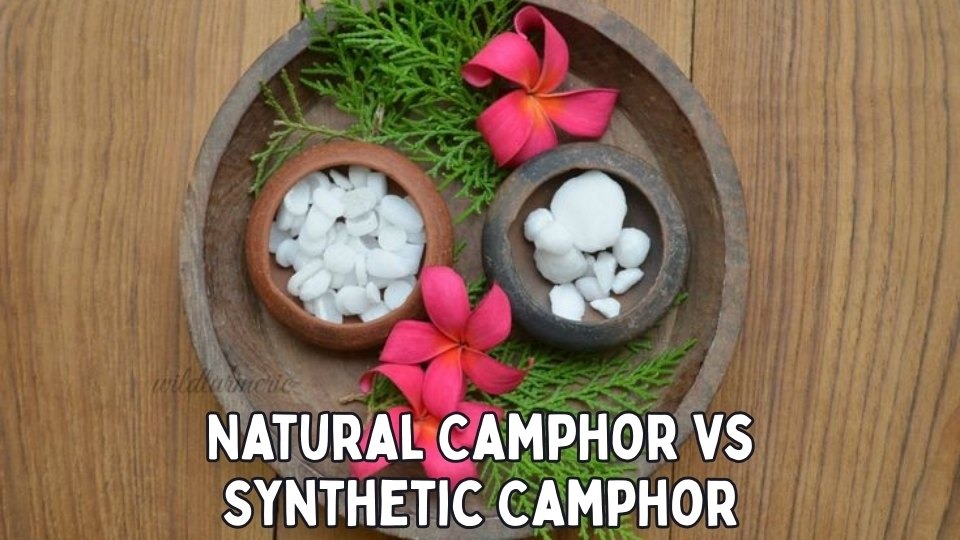
Natural Comphor vs Synthetic Comphor: Core Definition
What Is Natural Camphor?
Natural camphor is carefully extracted from the wood, bark, and leaves of the Cinnamomum camphora tree, commonly known as the camphor laurel tree, primarily cultivated in China, Japan, Taiwan, and parts of India. The standard extraction process involves steam distillation of wood chips, followed by sublimation and purification to yield pure white camphor crystals.
Because it originates directly from a plant source, natural camphor retains its full spectrum of bioactive compounds, making it far more potent and therapeutically valuable than any synthetic alternative available today.
What Is Synthetic Camphor?
Synthetic camphor is chemically manufactured in industrial settings, most commonly derived from alpha-pinene, a compound sourced from turpentine oil extracted from pine trees. Through a controlled series of chemical reactions, including oxidation and isomerization, alpha-pinene is systematically converted into camphor.
While synthetic camphor closely mimics the molecular structure of its natural counterpart, it frequently contains residual chemical impurities and lacks the complete therapeutic profile of plant-derived camphor. According to the World Health Organization (WHO), synthetic chemical compounds used in consumer products must meet strict purity thresholds to be considered safe for human use. ³
Natural Comphor vs Synthetic Comphor: Key Differences
Understanding how natural camphor vs synthetic camphor differ across multiple parameters empowers consumers to make smarter, safer, and more informed choices.
1. Source and Production Method
| Feature | Natural Camphor | Synthetic Camphor |
|---|---|---|
| Source | Cinnamomum camphora tree | Alpha-pinene / turpentine oil |
| Production | Steam distillation | Chemical synthesis |
| Purity | High (bioactive-rich) | Variable (may contain impurities) |
| Color | Bright white | Slightly dull white |
| Aroma | Rich, smooth, complex | Sharper, harsher, chemical-like |
| Burn residue | None (clean burn) | Black soot residue |
2. Chemical Composition and Purity
Natural camphor consists primarily of D-camphor (the dextrorotatory form), which is biologically compatible with the human body and delivers measurable medicinal benefits. Synthetic camphor, by contrast, frequently results in a racemic mixture of both D and L forms, which behaves very differently at a biochemical level. Research published in the Journal of Natural Products confirms that the stereochemical configuration of camphor significantly influences its medicinal efficacy and overall safety profile.
Health Benefits: Where Natural Camphor Clearly Wins
When comparing natural camphor vs synthetic camphor for health applications, natural camphor consistently demonstrates several clinically recognized advantages that make it the preferred choice for health and wellness.
Respiratory Relief
Natural camphor functions as a powerful expectorant and decongestant. When inhaled through steam inhalation or essential oil diffusers, it effectively loosens mucus buildup, opens restricted airways, and eases symptoms of colds, coughs, and bronchitis. This is precisely why it remains a trusted staple ingredient in numerous Ayurvedic formulations, chest balms, and respiratory remedies.
Antimicrobial and Anti-Inflammatory Properties
Peer-reviewed studies have demonstrated that natural camphor exhibits strong antimicrobial activity against a broad range of bacteria and fungi. Its well-established anti-inflammatory properties make it equally effective in topical applications targeting joint pain, arthritis, muscle soreness, and various skin conditions. According to research available through the National Institutes of Health (NIH), natural camphor compounds demonstrate measurable biological activity that synthetic alternatives cannot replicate. ⁵
Spiritual and Ritual Uses
In Hindu, Buddhist, and many South Asian cultural traditions, natural camphor is regarded as sacred and spiritually purifying. When burned during religious ceremonies, it combusts completely without leaving any black residue whatsoever. This clean, complete burn is a defining characteristic that synthetic camphor cannot replicate due to the residual chemical impurities it carries from the manufacturing process.
Safety Concerns: The 5 Dangerous Risks of Synthetic Comphor
This section is critically important for anyone researching natural camphor vs synthetic camphor from a health safety and consumer protection standpoint.
Top 5 safety risks associated with synthetic camphor:
- Chemical skin irritation: Contains manufacturing residues that may significantly irritate skin tissue and sensitive mucous membranes on contact.
- Food and skin application danger: Not recommended for use in food preparation or direct undiluted skin application due to impurity levels.
- Inhalation toxicity: Prolonged or concentrated inhalation can trigger headaches, nausea, dizziness, and respiratory discomfort in sensitive individuals.
- Child safety hazard: Toxic at high doses and particularly dangerous for infants and young children, who are far more vulnerable to camphor toxicity.
- Indoor air pollution: Burns with a visible black soot residue, indicating incomplete combustion and the release of potential indoor air pollutants.
The U.S. Food and Drug Administration (FDA) has established strict regulatory limits on camphor concentration in consumer products, particularly those intended for children, specifically because of these documented synthetic camphor risks.
Practical Uses: Choosing the Right Type for your Needs
When to Choose Natural Camphor
Natural camphor is the ideal choice for aromatherapy, religious and spiritual rituals, Ayurvedic medicine, and direct topical skin therapies. Its clean burn profile, therapeutically rich aroma, and high bioactivity make it the consistently preferred option for holistic health practitioners, Ayurvedic physicians, and health-conscious households worldwide.
When Synthetic Camphor May Be Acceptable
Synthetic camphor can serve as a cost-effective solution for strictly industrial applications such as non-consumer-grade mothballs, certain industrial chemical solvents, and non-inhalation-based commercial pest control products, where therapeutic quality and direct human exposure are not primary considerations.
Related reading: Top 10 Ayurvedic Ingredients for Home Wellness | How to Use Essential Oils Safely at Home
How to Identify Natural Comphor vs Synthetic Comphor at Home
Not sure which type you have purchased? These five expert-verified home tests will help you accurately identify natural camphor vs synthetic camphor with confidence:
- Burn test: Natural camphor burns cleanly with zero residue; synthetic camphor leaves visible black soot on nearby surfaces.
- Aroma check: Natural camphor produces a smoother, warmer, more rounded scent; synthetic camphor smells noticeably sharper and more chemical-like.
- Label inspection: Examine the ingredient list specifically for Cinnamomum camphora extract, steam-distilled camphor, or Bhimseni camphor.
- Price point: Authentic natural camphor costs significantly more than synthetic versions due to the labor-intensive, plant-based extraction process.
- Dissolution test: Natural camphor dissolves evenly and completely in pure coconut oil; synthetic camphor may leave small undissolved particles or a slightly cloudy residue.
Expert Recommendation
Holistic health professionals and certified Ayurvedic physicians consistently and unanimously recommend choosing natural camphor for any application involving direct human contact, inhalation, topical therapy, or food-adjacent use. The marginally higher cost is entirely justified by its superior purity, proven safety record, and significantly greater therapeutic effectiveness across all health applications.
As Dr. Vasant Lad, one of the world’s most respected Ayurvedic practitioners, explains in his authoritative text Ayurveda: The Science of Self-Healing, plant-derived compounds retain an inherent biological vitality and healing intelligence that synthetically manufactured alternatives fundamentally cannot replicate. You can explore his foundational work at The Ayurvedic Institute.
Frequently Asked Question (FAQ)
Q1: Is natural camphor safe to use around children?
Natural camphor in small, appropriate quantities can be used cautiously around older children, primarily in diffusers or topical balms. However, it should always be kept out of direct reach of infants and toddlers. Always consult a pediatrician before using any camphor-based product near children under age five.
Q2: Can I use camphor directly on my skin?
Natural camphor can be applied topically when properly diluted in a carrier oil such as coconut oil or sesame oil. Undiluted camphor, whether natural or synthetic, should never be applied directly to broken or sensitive skin. Synthetic camphor is generally not recommended for any direct skin application.
Q3: How long does natural camphor last once purchased?
Natural camphor has a shelf life of approximately two to three years when stored correctly in a sealed, airtight glass container away from direct sunlight and heat. Exposure to open air causes it to slowly sublimate and lose potency over time.
Q4: Why is synthetic camphor cheaper than natural camphor?
Synthetic camphor is produced at massive industrial scale through relatively low-cost chemical synthesis processes using petroleum or pine-derived alpha-pinene as raw material. Natural camphor requires carefully cultivated camphor laurel trees, labor-intensive steam distillation, and extensive purification steps, all of which increase production costs considerably.
Q5: Is natural camphor the same as Bhimseni camphor?
Yes. Bhimseni camphor, also known as Borneo camphor or Dryobalanops aromatica camphor, is considered a premium-grade variety of natural camphor. It is highly valued in Ayurvedic medicine and Hindu religious rituals for its exceptional purity, intense aroma, and remarkably clean, residue-free burn.
Q6: Can synthetic camphor be used in Hindu religious rituals?
While some households use synthetic camphor due to its lower price, most Ayurvedic scholars, Hindu religious authorities, and spiritual practitioners strongly advise against it. Natural camphor is specifically preferred because it burns completely without residue, is considered spiritually pure, and does not release harmful combustion byproducts indoors.
Conclusion
When it comes to natural camphor vs synthetic camphor, the scientific evidence is overwhelmingly clear: source, purity, and production method matter far more than most consumers ever realize. Throughout this comprehensive guide, we have explored how natural camphor, derived from the Cinnamomum camphora tree, consistently outperforms its chemically manufactured counterpart across health benefits, safety standards, spiritual applications, and overall therapeutic value.
Synthetic camphor may offer a lower price point, but the trade-offs including chemical residues, harsher aromas, incomplete combustion, indoor air pollution, and genuine health risks make it a poor choice for everyday household and wellness use. Whether you are using camphor for Ayurvedic healing, aromatherapy diffusion, religious rituals, or as a natural insect repellent, investing in authentic, plant-derived camphor is always the smarter and safer decision.
Research consistently supports the superior bioactivity and safety of naturally sourced camphor compounds, as confirmed by studies available through the National Institutes of Health (NIH).
Before your next purchase, always check product labels carefully, look for certified organic or Ayurvedic-grade certifications, and use the simple at-home identification tests detailed in this article. Choosing natural over synthetic is not merely a lifestyle preference. It is a well-informed, evidence-based health decision backed by modern science, ancient tradition, and trusted expert guidance.